
The impact of corporations on startup ecosystems is easy to underestimate. Most people think of founders, investors and government support when they picture a startup ecosystem. They may not think about the large companies that already operate in the region.
This leaves out an important part of the ecosystem. The impact of corporations on startup ecosystems can be wide. They can be customers, partners, investors and buyers. Corporations can also give startups access to skills, facilities and larger markets. An ecosystem that does not connect startups with these companies leaves useful support unused.
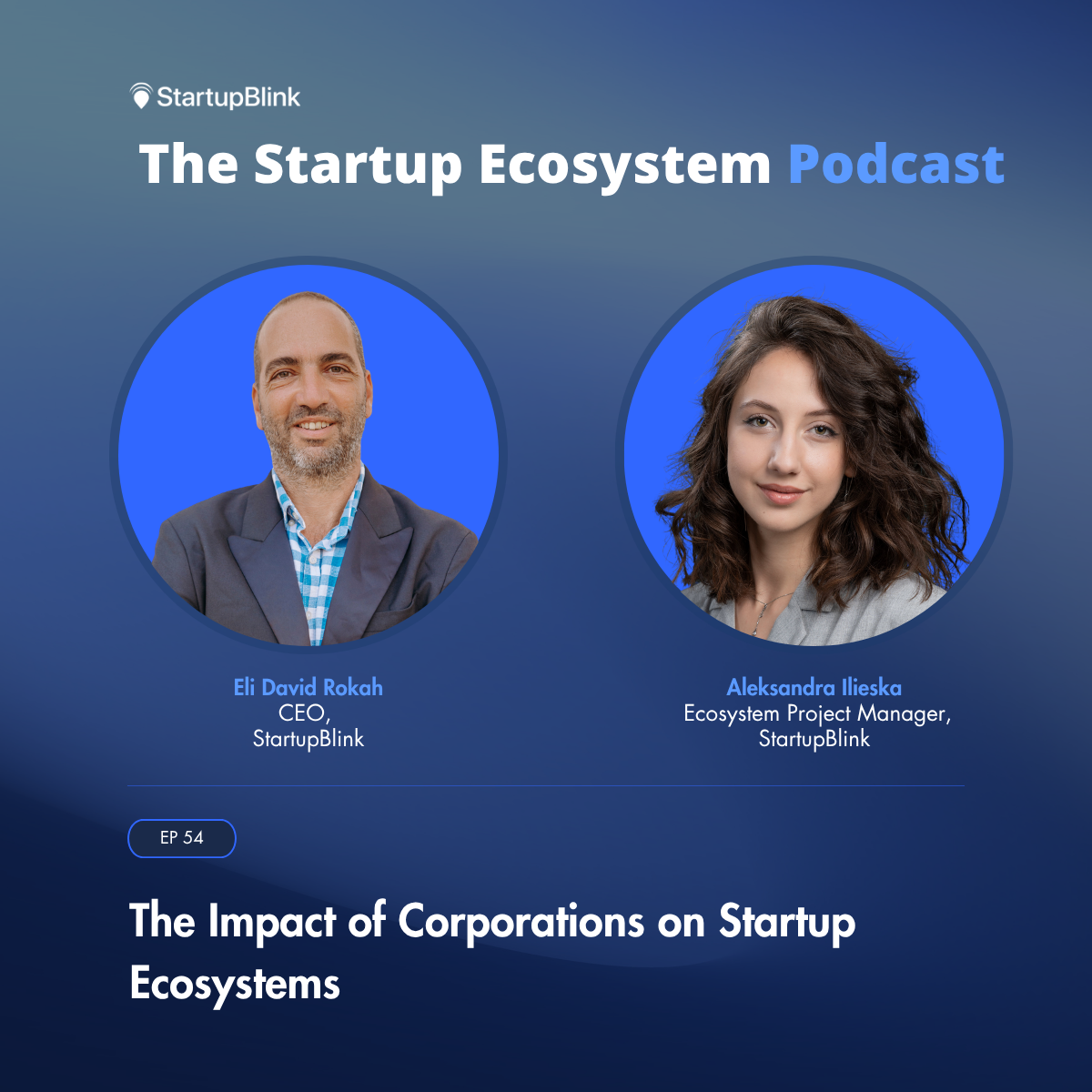
StartupBlink tracks how corporations work with startups through the Corporate Startup Activity Index. In episode 54 of the Startup Ecosystem Podcast, StartupBlink CEO Eli David Rokah and co-host Aleksandra Ilieska discuss what both sides gain from working together, why these partnerships can fail and how ecosystem developers can support them.
Listen to episode 54 on Apple Podcasts or Spotify, and subscribe to hear our next episode.
What Startup Ecosystems Gain From Corporations
Corporations can support startup ecosystems in several ways. Their role often goes beyond providing investment.
For Startups
Funding linked to business needs. A corporation may fund a startup for a different reason than a traditional investor. Investors usually focus on financial returns. A corporation may instead want to solve a specific problem in its business. When a startup is working on that problem, the company may be willing to fund development and testing. This can help startups building complex products that require more time or resources than standard investors are willing to provide. Corporate venture funds offer a formal way to make these investments.
Trust from customers and investors. A startup gains credibility when a large company becomes its customer, partner or investor. Other customers may see the relationship as proof that an established company trusts the product. Investors may also take the startup more seriously because its work has been tested in a real business setting. This support can make it easier for the startup to attract new customers, enter markets and raise investment.
Access to markets, facilities and experts. Many startups cannot build advanced research facilities or enter new markets on their own. Corporations can provide access to laboratories, equipment, industry experts, business contacts and customers in other locations. These resources and relationships could take a startup years to build without outside support. A startup that struggles to raise a traditional investment round may still grow when a corporation needs its product and is willing to pay for it.
Benefits for the wider ecosystem
These benefits extend beyond individual companies. Strong corporate activity makes an ecosystem more attractive to founders. It gives startups more ways to find customers, test products, raise funding and grow without leaving the region. Large companies also help build the local talent pool. They attract skilled workers through stable jobs, training and higher salaries. Some of these employees later start companies of their own, while others join local startups and help them fill important roles. Corporations therefore help ecosystems retain founders, develop talent and become more competitive.
Why Corporations Work With Startups
Corporations work with startups because they gain clear business value.
Large companies can be slow to build products in new fields. Their teams may know the main business well but have less experience with a new type of technology. A startup may be able to test and build a solution faster. This gives the corporation access to new products, ideas and skills without doing all the work inside the company.
This approach is often called corporate open innovation. It means that a company works with external startups and other partners to support its own research, product development and business goals. Working with independent startups can also help the ecosystem retain founders. A corporation gains access to the product or knowledge it needs, while the founders continue building their own company rather than joining the corporation as employees.
For these partnerships to continue, the value must be clear on both sides. Startups need customers, funding and access. Corporations need useful solutions that support their business goals.

How Ecosystem Developers Can Support Corporate-Startup Collaboration
Corporations do not always work with startups without outside support.
Many ecosystem plans focus on founders, investors and government programs but give little attention to large companies. Some corporations also have no clear process for working with startups. The problem can be greater in markets with little competition. A company that faces little pressure may have less reason to work with a startup. It may see the startup as a risk instead of a possible partner.
Government funding cannot solve this problem on its own. A grant can give a startup money. It cannot give the startup a customer, an industry partner, proof that the market wants its product or a possible buyer. These are forms of support that private companies can provide. Ecosystem developers should therefore bring corporations into the ecosystem instead of trying to replace them.
One way to start is to ask companies that receive tax support or other benefits what they contribute to local startups. Governments and ecosystem groups can set clear expectations for this support.
Local corporations may have a stronger duty to take part than foreign ones. Many sectors remain closely linked to the local market, including banking, energy, telecommunications and airlines. Large companies in these sectors often have deep roots in the country and are less likely to leave. Foreign corporations are different: they chose the location from several options and may move if another location offers better conditions. Ecosystem developers should encourage local corporations to do more. They should also give foreign corporations good reasons to stay and work with local startups.
Public recognition can help. Ecosystem developers can thank and promote the companies that support startups. This gives active companies a reason to continue and shows which large companies are still doing little.
Connect corporations to the right startups. See how StartupBlink helps organisations reach and work with startups through our promotion and partnership services.
Why Corporate-Startup Partnerships Are Challenging
Corporations and startups often work in different ways.
Corporations must follow legal rules, purchasing procedures, security checks and internal approval processes. A young startup may have little experience with these requirements. The corporation may record each decision and move through several departments before approving a pilot. The startup may use fewer steps and expect faster decisions. Neither side is always wrong. However, these differences can end a partnership when expectations are not agreed in advance.
Founders need to understand that corporations may require more checks and accept less risk. Corporations need to understand that a young startup cannot operate like a large, established supplier. Before the work begins, both sides should agree on:
- What problem the partnership is expected to solve
- What each side must deliver
- How and when the startup will be paid
- Who owns the product and intellectual property
- How long approval and testing may take
- What happens after the pilot ends
Choosing the right partner is also important. A strong product is not enough if it does not match the corporation’s needs, timeline or ability to run a pilot. We cover this in our guide on how to pick the right startups for corporate partnerships.
Corporate startup programs can also be unstable because they often sit outside the company’s main business. When a corporation faces financial pressure, these programs may be among the first activities to be cut. Intel Ignite shows this risk. The program supported startups for several years without taking equity. Intel later closed it while facing financial challenges. The team then restarted it independently, which reduced the impact on participating startups.
The case shows why ecosystems should not depend on one corporation or program. Each closure removes one possible source of customers, funding, advice or business connections. A strong ecosystem should have several active corporations and different routes through which startups can reach them.
How Corporate-Ready Is Your Ecosystem?
Ecosystem developers can review their position by asking these five questions:
- Does the written ecosystem strategy include corporations?
- Which local companies work with startups, and which do not?
- Can a local founder reach a decision-maker at a large company?
- What do foreign corporations receive from the ecosystem, and what do they contribute?
- What would happen if the largest corporate startup program closed next year?
The answers can show the difference between an ecosystem that simply contains startups and one that actively connects them with customers, partners and investors.
What You Can Learn from the Corporate Startup Activity Index
Corporate activity helps show whether startups in a location can access large companies that may become customers, partners, investors or buyers.
For founders, this information can help identify ecosystems with strong corporate opportunities. For ecosystem developers, it can show where corporate support is working and where more action is needed.
The impact of corporations on startup ecosystems should form part of any review of ecosystem strength. Funding matters, but startups also need customers, business partners, market access and routes to growth.
For the full discussion, listen to episode 54 of the Startup Ecosystem Podcast. Eli David Rokah and Aleksandra Ilieska explain how corporations and startups work together and what the wider ecosystem gains.
See which corporations lead on startup activity. Explore the Corporate Startup Activity Index.
For more on the main parts of a strong ecosystem, read How to Build a Strong Startup Ecosystem.