
Finding the best countries for startups in 2026 helps founders, investors, and ecosystem builders see where startup conditions are strongest. The right country can improve access to funding, talent, customers, infrastructure, and regulation.
In addition, strong national startup ecosystems help founders build globally competitive companies. They also make it easier to connect with investors, hire skilled teams, and expand into larger markets.
In this article, we highlight the best countries for startups in 2026 based on the StartupBlink Global Startup Ecosystem Index 2026. The Index covers 120 countries and more than 1,500 cities using hundreds of thousands of data points including startup count, funding activity, unicorn presence, business environment, and dozens of other indicators that measure the strength and success of startup ecosystems.
Want to see rankings beyond the top 10? Download the Global Startup Ecosystem Index 2026 Report to explore the best startup countries, cities, regions, industries, ecosystem trends, and methodology.
Which country is best for startups and entrepreneurs?
The United States is the best country for startups and entrepreneurs in 2026. It ranks first globally in StartupBlink’s Global Startup Ecosystem Index with a total score of 314.096.
The United Kingdom follows in second place with a score of 80.114. Israel ranks third with 71.462, while Singapore ranks fourth with 68.043.
Singapore also recorded the highest growth rate among the global top 10 countries at 24.4%.
What changed among the best countries for startups in 2026?
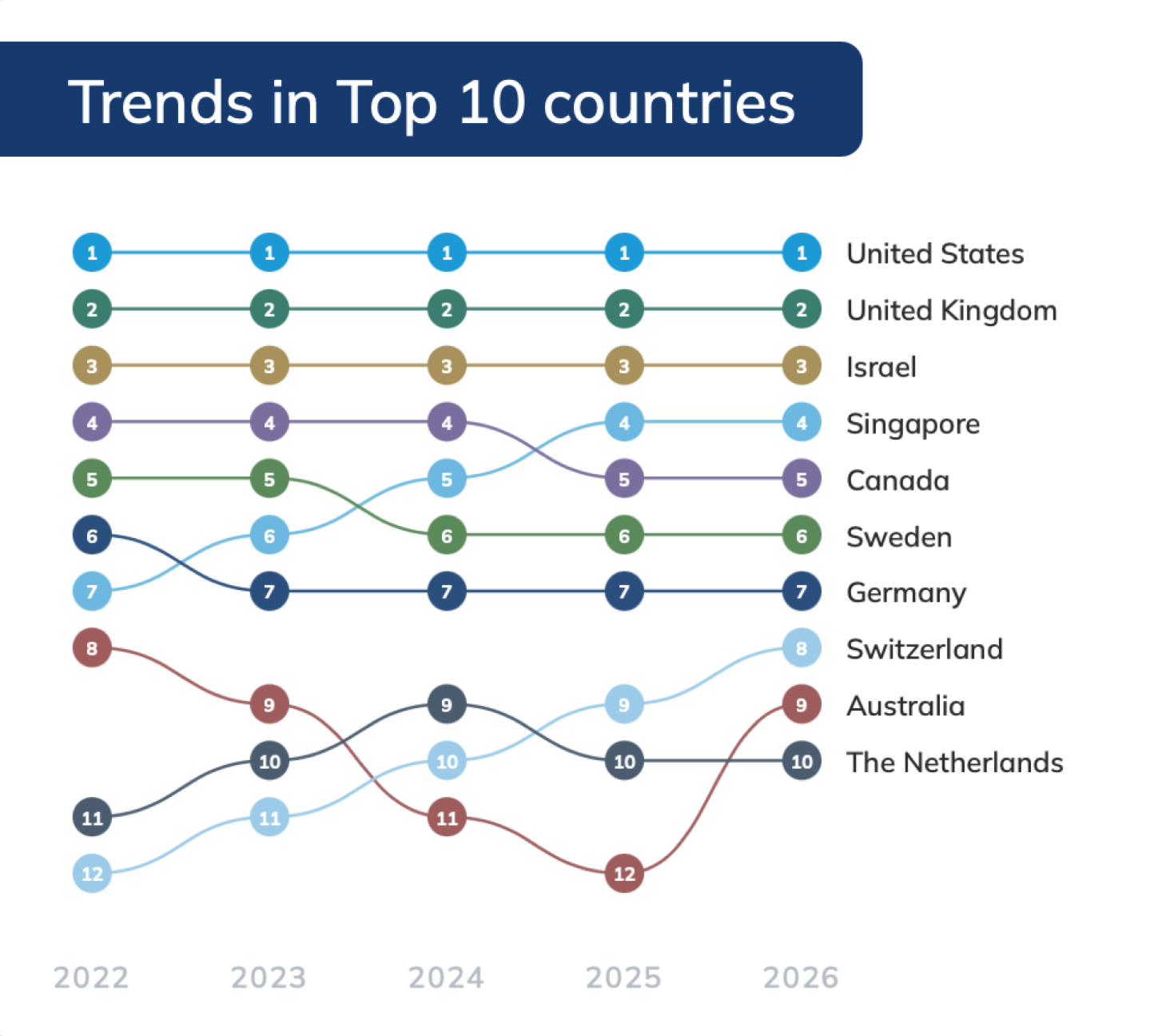
According to the Global Startup Ecosystem Index 2026, the top seven countries all held their 2025 positions. Overall, the top 10 recorded an average growth rate of 16.7%.
Several leading ecosystems grew faster than the group average. The United States, Israel, Singapore, and Sweden each grew by 15% or more. By contrast, the United Kingdom, Canada, and Germany showed lower growth rates.
Only two countries changed position within the top 10. Switzerland rose to 8th, while Australia climbed to 9th. Meanwhile, France was the only country to leave the top 10, falling from 8th to 11th.
Sweden remained the top-ranked country in the European Union. However, the EU still has no member country in the global top five.
The table below shows the top startup countries in 2026 by total ecosystem score. It also includes rank changes, annual ecosystem growth, and ecosystem value.

The StartupBlink Global Startup Ecosystem Index 2026
| Rank 2026 | Country | Annual Growth | Total Score 2026 | Ecosystem Value |
|---|---|---|---|---|
| 1 0 | United States | +23.6% | 314.096 | US$ 9.1T |
| 2 0 | United Kingdom | +13.2% | 80.114 | US$ 996.9B |
| 3 0 | Israel | +15% | 71.462 | US$ 335.1B |
| 4 0 | Singapore | +24.4% | 68.043 | US$ 292.1B |
| 5 0 | Canada | +9% | 49.534 | US$ 361.8B |
| 6 0 | Sweden | +15.5% | 40.781 | US$ 152.4B |
| 7 0 | Germany | +13.5% | 37.644 | US$ 452.3B |
| 8 +1 | Switzerland | +13.7% | 36.108 | US$ 145.0B |
| 9 +3 | Australia | +22.9% | 35.438 | US$ 195.2B |
| 10 0 | The Netherlands | +11.8% | 34.514 | US$ 164.5B |
Top 10 Countries for Startups in 2026
1. United States
The United States remains the top startup nation globally in 2026, clearly ahead of the rest. Its lead over the United Kingdom has widened to nearly four times, up from 3.7 times last year. The U.S. records an ecosystem growth rate of 23.6%, the highest among the top three, signaling a further strengthening of its lead.
The number of U.S. cities in the global top 100 rose to 33, up from 32 last year, and 226 cities now appear in the global top 1,000, including 15 new entries this year. 52% of ranked U.S. cities rise in the rankings, indicating an overall upward trend.
2. United Kingdom
The United Kingdom holds firm at 2nd globally for the sixth consecutive year, remaining Europe’s leading startup ecosystem. Its total score is nearly twice that of Sweden (6th) and more than double that of Germany (7th). With a growth rate of 13.2%, the UK is among the slower-growing ecosystems in the top 10, suggesting growth has leveled off.
The UK has 70 cities in the global top 1,000, including four in the top 100, though 54% declined in the rankings this year. London continues to dominate domestically, with a score 16 times higher than the next-ranked UK city, Manchester.
3. Israel
Israel remains in third place globally for the sixth consecutive year. The total score gap with the United Kingdom narrows from 13.8% to 12.1%, reversing the previous year’s widening trend. Israel records growth of 15.0%, higher than several top-10 ecosystems including the UK, showing resilience despite ongoing geopolitical pressures.
The country has 10 cities in the global top 1,000, down from 12 last year, with seven recording negative growth. Israel ranks 2nd globally in Software & Data, its strongest industry. Tel Aviv rises to 7th globally, its highest position in the last five years.
4. Singapore
Singapore holds 4th place in 2026 after its historic leap last year, continuing its remarkable rise from 10th in 2021, the largest gain among the current top 10 over this period. Singapore records the highest ecosystem growth rate in the top 10 at 24.4%, well above the global average of 17.5%, and ranks 2nd globally in both Fintech and Ecommerce & Retail.
Singapore City also enters the global top 10 for the first time, rising to 10th, with the highest growth rate among top 10 cities.
5. Canada
Canada keeps its position at 5th place in 2026 but records the lowest growth rate in the top 10 at just 9%, confirming a two-year slowdown that has continued since its 3rd-place ranking in 2019.
Canada’s number of cities in the global top 1,000 decreased from 39 to 33, with only eight rising in the rankings. Despite this pressure, Toronto returns to the global top 20 for the first time in six years, climbing to 18th and emerging as the country’s primary source of ecosystem momentum. Canada holds top-3 positions globally in Edtech, Energy & Environment, and Transportation.
6. Sweden
Sweden holds its 6th-place position globally for the third consecutive year and remains the top-ranked country in the European Union. It also retains second place in Europe behind the UK. The total score gap with Germany (7th) stands at 8%, a margin that could shift with a stronger year from either side.
The number of Swedish cities in the global top 1,000 decreased from 19 to 14, with only two of the 14 ranked cities rising. Stockholm slips one spot to 25th globally but remains the highest-ranked startup hub in the Nordics.
7. Germany
Germany continues to hold 7th place globally for the fourth consecutive year. It records growth of 13.5%, a moderation compared with last year, leaving its position broadly unchanged. Germany has 49 cities in the global top 1,000, the highest count in the EU, though this is down from 53 last year.
Berlin remains the leading startup hub, though both Berlin (-2.6%) and Munich (-2.1%) contracted this year, signaling negative momentum in Germany’s top ecosystems. Growth is more pronounced in mid-sized cities, with 13 German cities recording growth above 30%.
8. Switzerland
Switzerland climbs one spot to 8th globally in 2026, overtaking France and completing a four-year recovery from its 12th-place low in 2022. In Europe, Switzerland rises from 5th to 4th, returning to its 2021 position. With growth of 13.7%, Switzerland sits in the middle of the European pack.
The country has 16 cities in the global top 1,000, unchanged from last year, and remains the only country in the global top 10 without a city in the global top 50. Switzerland’s leading industries are Fintech and Healthtech, where it ranks 6th globally, and it also ranks 5th globally in Blockchain.
9. Australia
Australia returns to the global top 10 in 2026, climbing three places from 12th to 9th, the largest single-year gain among the top 15 countries. This marks a reversal after three consecutive years of decline from 8th in 2022 to 12th in 2025. Australia records 22.9% growth, the third-highest rate in the global top 10, behind Singapore and the United States.
The country has 14 cities in the global top 1,000, all recording positive growth. Sydney enters the global top 30, while Melbourne makes the stronger climb, jumping eight places to 34th with 37.8% growth. Australia also ranks 5th globally in Ecommerce & Retail, its strongest industry.
10. Netherlands
The Netherlands ranks 10th globally for a second consecutive year and becomes the 3rd-ranked ecosystem in the EU, with the gap to France (11th) and Estonia (12th) under 4%, making it one of the tightest races in the Index. Ecosystem growth is modest at 11.8%, trailing other top-10 ecosystems.
The Netherlands has 22 cities in the global top 1,000, including 11 climbers and one new entrant. Amsterdam slips one place to 27th globally but remains Europe’s 5th-ranked city. Hardware & IoT is its leading industry, ranking 8th globally and 3rd in Europe.
What is the StartupBlink Global Startup Ecosystem Index?
The Global Startup Ecosystem Index is an annual ranking of startup ecosystems around the world. In 2026, the Index ranks 120 countries and 1,556 cities, providing a global benchmark for startup ecosystem performance.
StartupBlink builds the Index using hundreds of thousands of data points. Each ecosystem’s total score is based on three main subscores: Quantity, Quality, and Business Environment.
Quantity measures the level of startup activity. Quality measures ecosystem impact and startup success. Meanwhile, Business Environment evaluates the national conditions that affect how easily startups can be established, operated, and scaled.
In 2026, StartupBlink also introduced Ecosystem Value as an additional indicator. This metric estimates the financial value of a startup ecosystem based on startup valuations and exits since 2006.
As a result, the full report gives more context beyond the headline rankings. It also includes country rankings, city rankings, industry strengths, ecosystem trends, and methodology.
While this article focuses on the top 10 countries, the full report includes deeper insights into global ecosystem trends, country and city rankings, industry strengths, methodology, and analysis of more than 1,500 cities and 120 countries.
Curious to see where your ecosystem ranks? Download the full Global Startup Ecosystem Index Report to explore the complete rankings and methodology.
Frequently Asked Questions
Which top startup country grew the fastest in 2026?
Among the global top 10 startup countries, Singapore recorded the highest annual growth rate in 2026 at 24.4%, reaching a total score of 68.043. Singapore’s growth reflects its continued rise as a global startup hub, with strong performance in Fintech, Ecommerce & Retail, and Singapore City’s entry into the global top 10 cities.
Which country is best for startups in Europe?
The United Kingdom is the top startup country in Europe according to the Global Startup Ecosystem Index 2026, ranking 2nd globally with a total score of 80.114. Sweden is the highest-ranked country in the European Union at 6th globally with a score of 40.781, followed by Germany (7th, 37.644), the Netherlands (10th, 34.514), and France (11th, 33.942).
Which countries are leading startup ecosystems in Asia-Pacific?
According to the Global Startup Ecosystem Index 2026, the leading startup countries in Asia-Pacific are Singapore (4th globally, total score 68.043) and Australia (9th globally, total score 35.438). Singapore records the highest growth rate among the top 10 countries at 24.4%, while Australia returns to the global top 10 after climbing three places.
What makes a country good for startups?
The Global Startup Ecosystem Index defines a good startup ecosystem through objective and quantifiable measurements, rather than opinions, surveys, or assumptions. It evaluates ecosystems based on measurable startup output across three main areas: quantity, quality, and business environment.
A good startup ecosystem is one with many active startups and support organizations, strong startup outcomes such as funding, exits, unicorns, jobs, and traction, and a business environment that allows founders to start, operate, and scale companies effectively. In this sense, a strong ecosystem is not simply one that appears innovative, but one that demonstrates measurable entrepreneurial activity, impact, and growth.
What is the difference between city and country startup rankings?
Country rankings in the Global Startup Ecosystem Index adjust for population size, while city rankings do not. This means a country may rank highly because it has strong startup output relative to its population, whereas city rankings reflect absolute ecosystem strength. A country may rank highly because it has one dominant startup city, several strong cities, or broad startup activity across many locations.