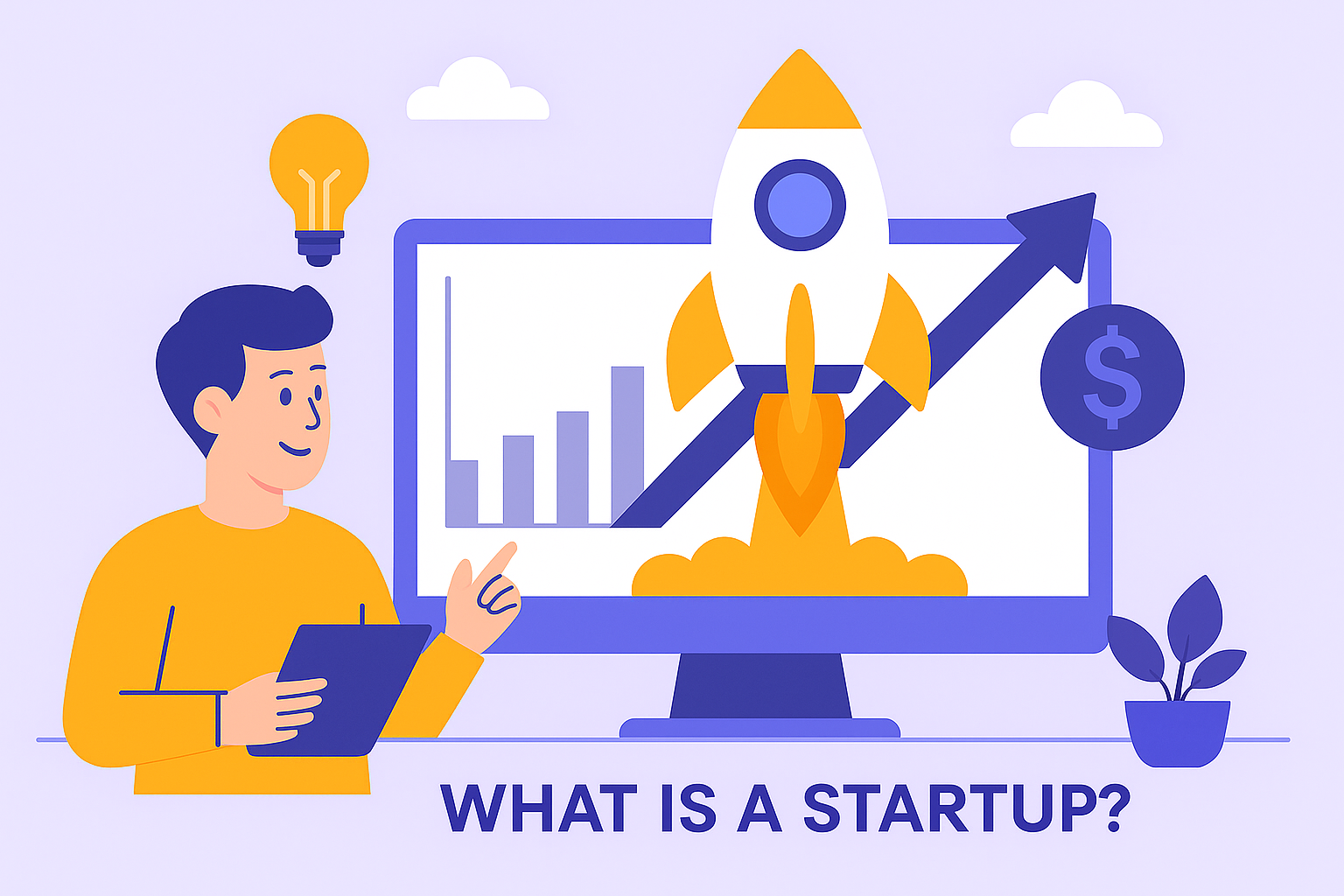

A startup is an innovative, technology-enabled company built to scale. The innovation can be a product, service, process or business model. Scalability means the company can grow quickly without its costs rising in step with its revenue. Startups work under uncertainty, test ideas fast and aim to reach far beyond their home city. Innovation, scalability and the intent to grow define a startup, whatever its source of funding.
How StartupBlink Defines a Startup
StartupBlink tracks more than 270,000 startups across 1,500+ cities in 120+ countries. Our Global Startup Ecosystem Index 2026 ranks ecosystems on the quantity and quality of their startups, so we need clear rules for what counts as a startup.
For us, the deciding factor is innovation: a business that applies an innovative, technology-enabled solution, or a uniquely scalable business model, with the potential to scale. When we review a company for our map, we look for:
- A distinct product with a strong user experience
- A solution that can serve national or international markets, beyond a local client base
- Early traction and a clear plan to expand
- Growth momentum, whether the company is backed by angels or VCs or bootstrapped
We apply some flexibility in developing markets, where teams may show ambition and scalability through different early signals. Country-specific domains are fine when there are signs of wider ambition.
Traditional service providers, agencies and local directories, such as real estate listings or purely local services, don’t qualify, and we don’t feature them on our map.
Does your company fit? If your startup meets these criteria, add it to the StartupBlink map. Our team reviews every submission before it goes live.
Startup vs. Small Business
Every startup starts small, but most small businesses are not startups. The difference lies in what the company is built to do. A startup aims for rapid growth into large, often international markets, using an innovative model it can repeat at scale. A small business aims for a stable, profitable operation, usually serving a local market with a proven model such as a shop, restaurant or agency.
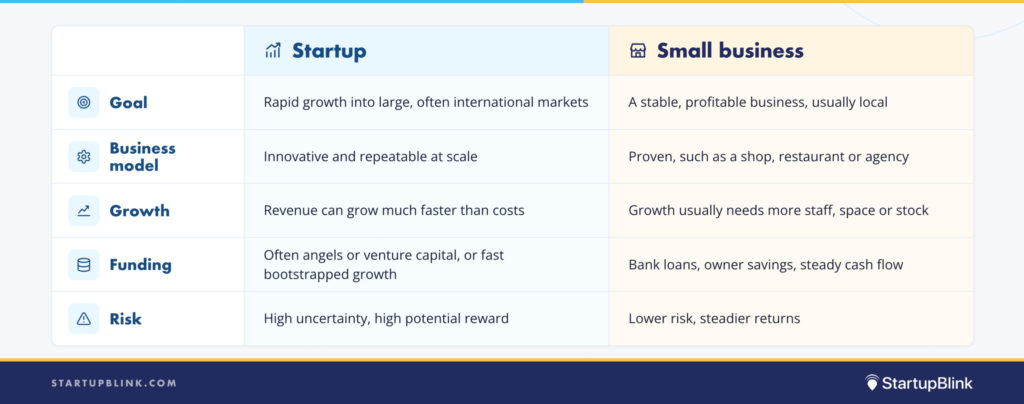
That difference shapes how each one grows and is funded. A startup’s revenue can grow much faster than its costs, while a small business usually needs more staff, space or stock to grow. Startups often raise money from angel investors or venture capital, or grow quickly on their own revenue. Small businesses tend to rely on bank loans, owner savings and steady cash flow. As a result, startups carry high uncertainty with the chance of a high reward, while small businesses take lower risks for steadier returns.
A neighborhood bakery and a food delivery app may both start with three people. The bakery can only serve customers who walk in, while the app can add a new city without building a new kitchen. That ability to scale is what makes it a startup.
How do startups grow beyond their home market? Listen to StartupBlink CEO Eli David Rokah and Mahmod Shamsi on how startups scale globally.
Follow the Startup Ecosystem Podcast on Apple Podcasts | Spotify
The 4 Key Characteristics of Startups
1. Small Size, Big Impact
Most startups begin with a small team building a minimum viable product (MVP) to test whether the idea solves a real problem. Once they show traction, even early traction, they can attract more customers, investors and partners.
Team size isn’t a criterion. A company can innovate at any size. What sets startups apart is the intent and ability to scale: to reach large markets and grow fast relative to their size. That requires a team that can change direction quickly when the market, technology or competition shifts.
2. High Risk of Failure
Startups begin with limited resources and untested assumptions, so many fail. Eric Ries, author of The Lean Startup, defines a startup as “a human institution designed to create a new product or service under conditions of extreme uncertainty.”
Successful founders treat setbacks as information. Each failed test shows what to fix in the product, the market or the business model.
3. Talent-Driven Teams
A startup depends on people who learn fast, handle pressure and believe in the mission. When team members can see the direct impact of their work, they stay committed through the hard early years and help the company grow faster.
4. Non-Traditional Financing
Many startups begin with the founders’ own money, sometimes with help from friends and family. Their main assets, such as technology, intellectual property and the team, are intangible, and profits often come late, so banks rarely lend to them.
Angel investors, venture capital and venture debt fill that gap, often bringing advice and contacts along with the money. Equity crowdfunding, accelerators and government innovation grants also support early-stage companies. Some startups grow entirely on their own revenue, but outside investment is usually a sign that investors see real growth potential.
Researching startups or new markets? StartupBlink Ecosystem Pro Research gives your team data on 1,500+ ecosystems and 250,000+ startups, with bespoke reports and custom dashboards. Teams use it to compare locations, benchmark peers and track industries. Book a demo
Examples of Startups (and What Isn't One)
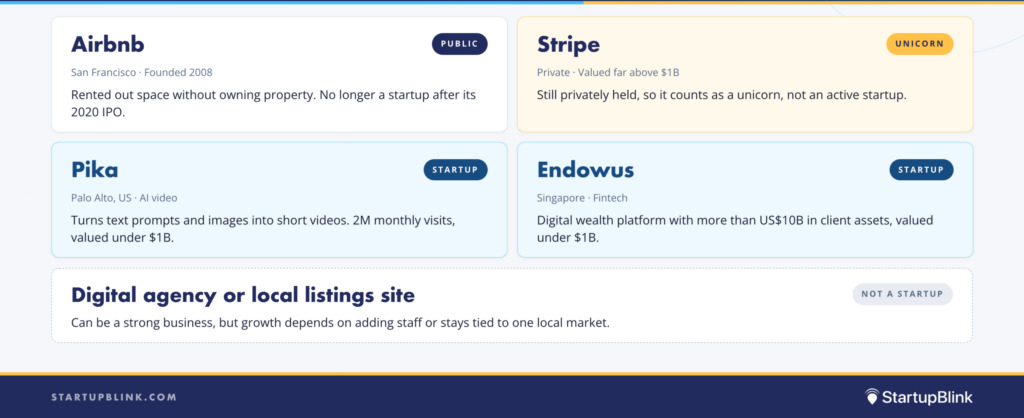
- Airbnb began in 2008 as a business-model startup: it rented out space without owning any property. After its IPO in 2020, it no longer counts as a startup in our framework.
- Stripe is still privately held, but its valuation is far above $1B, so we count it as a unicorn, not an active startup.
- Pika, based in Palo Alto, turns text prompts and images into short AI-generated videos. It draws about 2 million monthly visits and is valued under $1B, so it counts as an active startup.
- Endowus, based in Singapore, is a digital wealth platform with more than US$10 billion in client assets. Valued under $1B, it is an active startup.
- Not a startup: a digital marketing agency or a local real estate listings site. Both can be successful businesses, but their growth depends on adding staff, or stays tied to one local market.
When Does a Company Stop Being a Startup?
There is no fixed age limit. In our framework, a company leaves the active startup count when one of the following happens:
- It stops operating. This is the most common reason.
- It reaches unicorn status, a private valuation above $1B.
- It becomes a publicly traded company.
- It is acquired before reaching a $1B valuation.
Unicorns and exits valued above US$1 billion still count in our rankings as special entities, because they bring capital and a strong success story to their ecosystems.
For governments and ecosystem leaders, these milestones mark a maturing ecosystem. Startup Ecosystem Membership shows how your city or country compares with 1,500+ ecosystems and where to improve next.
To see where startups are most active, explore the best cities for startups, the best countries for startups and our guide to startup industries.
Frequently Asked Questions
How old can a startup be?
There is no set age. A company stays a startup while it is still building toward scale. It stops being one when it closes, reaches a $1B valuation, goes public or is acquired.
Is every tech company a startup?
No. A tech company that serves a fixed local market, or sells services billed by the hour, is not a startup. What matters is an innovative product or model that can scale.
Do startups need investors?
No. Many startups are bootstrapped, and some scale entirely on their own revenue. Outside investment is common because it signals growth potential, but it is not part of the definition.
See how 1,500+ startup ecosystems compare in the Global Startup Ecosystem Index 2026.