


A startup industry, or vertical, is the sector a startup’s product serves, such as fintech, health or transportation. StartupBlink groups startups into 11 industries and 84 subindustries, and uses them to rank cities and countries in each sector, alongside its general Global Startup Ecosystem Index.
This guide explains each of the 11 industries, the subindustries within them, and why industry focus matters for founders, governments and investors.
What Are Startup Industries?
Startup industries, also called verticals, group startups by the market they serve. Some startups target a broad market from day one, while others focus on one vertical and build deep expertise in it, such as payments within fintech or medtech within health.
The industry a startup belongs to shapes a lot: which investors back it, which corporations become its customers, and which cities give it the strongest talent and networks. A fintech startup gains from being close to banks and financial regulators, while a hardware startup needs manufacturing partners nearby.
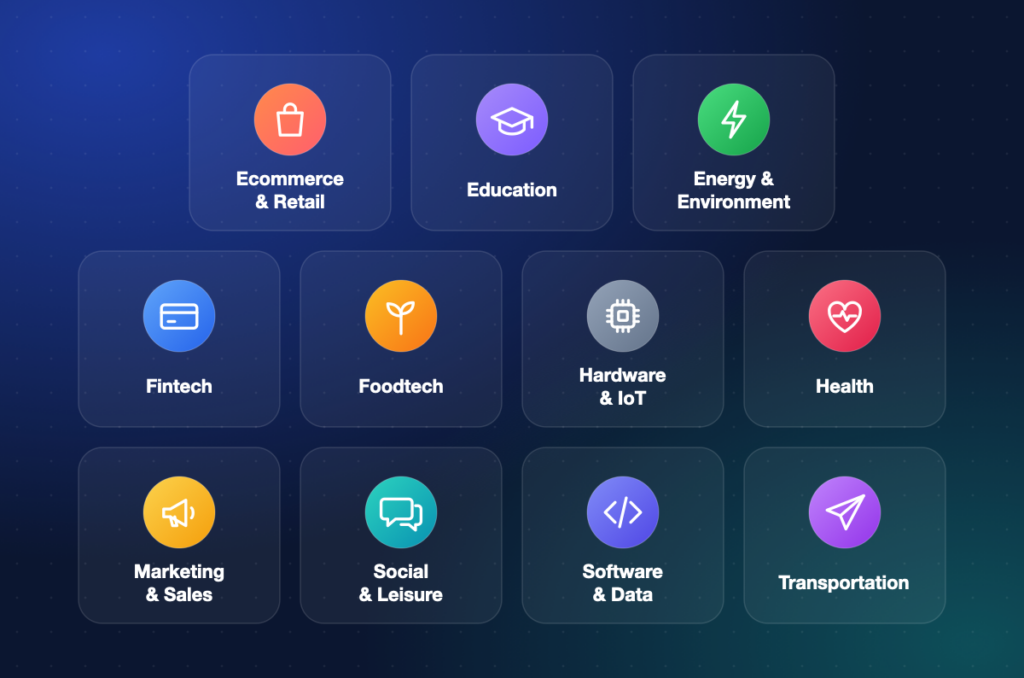
The 11 Startup Industries
Every startup on the StartupBlink map is assigned to one of the following industries and a subindustry within it, and is ranked against other startups in the same sector.
Ecommerce & Retail
Startups that change how people buy and sell, from online stores and marketplaces to property technology and retail tools. Subindustries include Consumer Goods, Ecommerce, Marketplaces, Proptech, Retail and Social Commerce.
Education
Edtech startups that change how people learn and teach, from online courses and learning platforms to tools for schools and universities.
Energy & Environment
Startups working on clean energy, sustainability and the transition to a low-carbon economy. Subindustries include Clean Energy, Cleantech, Energy, Sustainability and Waste Management.
Fintech
Startups that make financial services faster, cheaper and easier to use, from payments and digital banking to insurance and investment. Subindustries include Accounting, Blockchain, Cryptocurrency, Financial Services, Financial Technology, Insurance, Investment, Online Banking, Payments and Personal Finance. See our list of top fintech startups.
Foodtech
Startups across the food chain, from farming technology to food production and online ordering. Subindustries include Agtech, Food and Beverage, Food Manufacturing and Online Food Ordering. See our list of top foodtech startups.
Hardware & IoT
Startups building physical products, from consumer electronics and robotics to connected devices and smart city technology. Subindustries include 3D Printing, Consumer Electronics, Hardware, Manufacturing, Nanotechnology, Robotics, Internet of Things and Smart Cities. See our list of top hardware and IoT startups.
Health
Startups improving health care and the life sciences, from medical devices and biotech to fitness and care for older people. Subindustries include Health Care, Life Sciences, Assisted Living, Biotechnology, Cannabis, Fitness, Medtech and Pharmaceuticals. See our list of top healthtech startups.
Marketing & Sales
Startups that help businesses reach and sell to customers, from advertising technology to CRM and event platforms. Subindustries include Adtech, Content Marketing, CRM, Digital Marketing, Events and Sales.
Social & Leisure
Startups in how people connect and spend their free time, from social media and gaming to sports, arts and travel. Subindustries include Arts, Communities, Digital Media, Entertainment, Gaming, Social Media, Sports and Travel. See our list of top gaming startups.
Software & Data
Startups building software and data products, from cloud and SaaS to cybersecurity and artificial intelligence. Subindustries include Apps, Artificial Intelligence, Cloud, Comtech, Cybersecurity, Data Analytics, Enterprise Technology, SaaS, Software, VR/AR and Web Development. See our list of top AI startups.
Transportation
Startups moving people and goods, from logistics and automotive technology to aviation, shipping and ride-hailing. Subindustries include Aerospace, Automotive, Aviation, Logistics, Maritime, Public Transportation and Ride-Hailing. See our list of top transportation startups.
Why Industry Focus Matters
For founders, the right ecosystem depends on the industry. A city can rank modestly overall but lead the world in one sector, giving startups in that sector better access to specialist investors, talent and customers. Comparing industry rankings, not just overall rankings, helps founders choose where to build or expand.
For governments, most ecosystems grow fastest by focusing on a few industries where they already have an advantage, such as a strong university, a major industry or a large local market, and becoming leaders in them. Trying to support every sector equally usually spreads resources too thin. StartupBlink helps governments benchmark their ecosystem’s industries against 1,500+ cities and choose where to focus. See how your ecosystem compares.
For corporations and investors, industry data shows where the most promising startups in a sector are emerging. StartupBlink Ecosystem Pro Research gives teams data on 1,500+ ecosystems and 270,000+ startups, with custom reports and dashboards for tracking industries and benchmarking locations. Book a demo.
Building a startup? Add it to the StartupBlink map so investors, corporations and ecosystem builders can find it in your industry’s rankings.
Frequently Asked Questions
What are the main startup industries? StartupBlink tracks 11: Ecommerce & Retail, Education, Energy & Environment, Fintech, Foodtech, Hardware & IoT, Health, Marketing & Sales, Social & Leisure, Software & Data, and Transportation. Together they include 84 subindustries.
What is the difference between an industry and a subindustry? An industry is a broad sector, such as Fintech. A subindustry is a narrower area within it, such as Payments or Insurance. Each subindustry belongs to one industry.
















People reacted to this story.
Show comments Hide comments[…] You can read more about each vertical here. […]
Comments are closed.