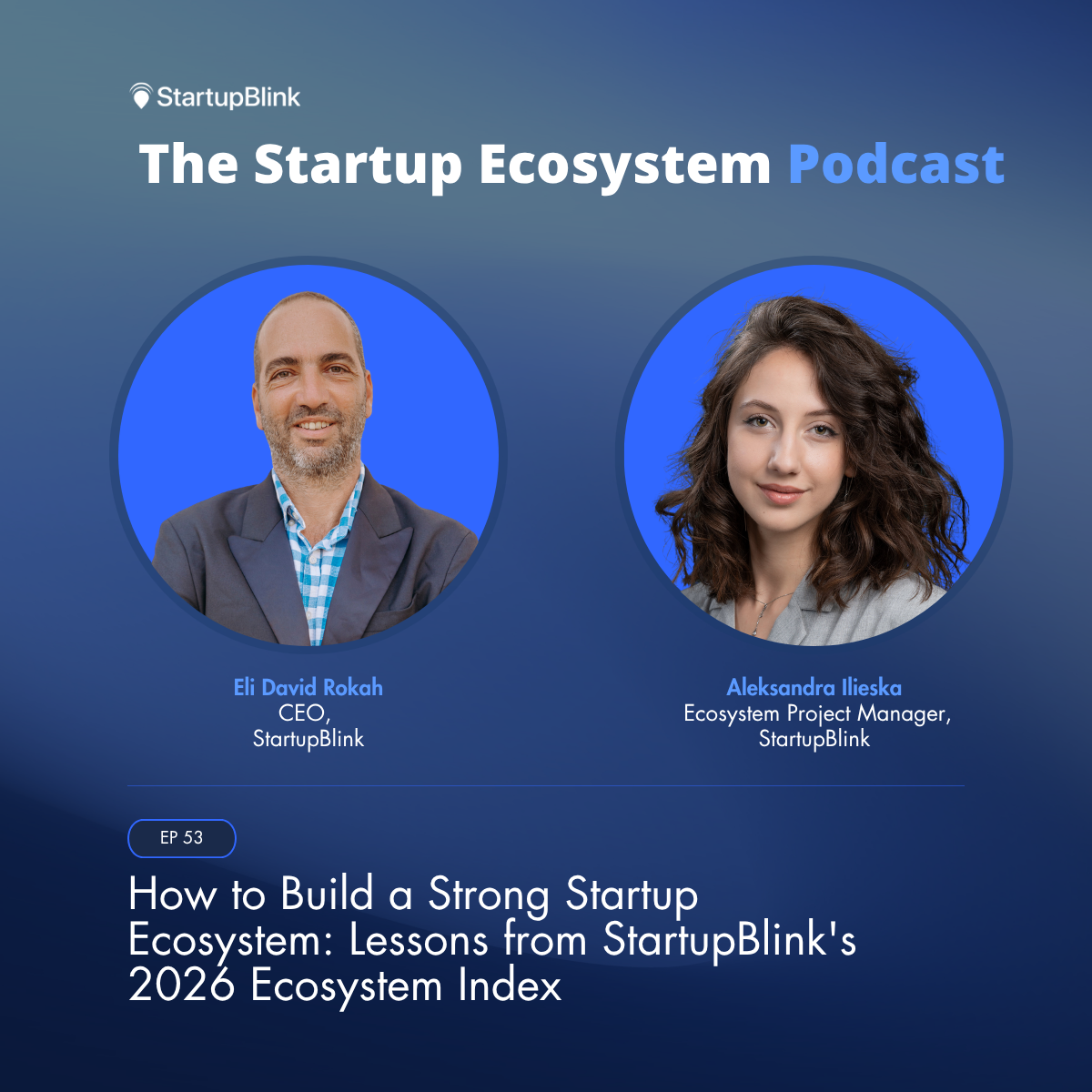

For years, efforts to build a strong startup ecosystem have often followed a familiar formula: launch an accelerator, distribute grants, organize events, and create new support programs for founders.
But do these interventions actually produce stronger startup ecosystems?
In a new episode of the Startup Ecosystem Podcast, StartupBlink’s CEO, Eli David Rokah explores what the Global Startup Ecosystem Index 2026 reveals about the countries and cities gaining momentum, and why some traditional approaches to ecosystem development may be doing more harm than good.
Get a head’s up on our next podcast episode — Subscribe on Apple Podcast, or Spotify!
The conversation also examines StartupBlink’s complementary Innovators Business Environment Index, which evaluates how attractive a country’s policies and business conditions are for founders and innovative companies.
Together, the two indices offer startup ecosystem developers a more complete way to evaluate performance: one measures the results an ecosystem produces, while the other examines the environment in which entrepreneurs must operate.
Here are five of the most important lessons for policymakers, economic development organizations and startup ecosystem builders.
1. Build the Right Business Environment Before Creating More Programs
A successful startup ecosystem requires more than funding programs and founder support initiatives. Entrepreneurs also need an environment in which starting, operating and scaling a company is relatively straightforward.
Complex regulations, high administrative burdens, unpredictable policies and difficult business procedures create additional challenges for founders who are already dealing with the uncertainty of building a startup.
As discussed in the episode, entrepreneurs should be able to focus on their primary challenge: creating a product, finding customers and building a sustainable company. They should not also have to fight an uncooperative business environment.
For startup ecosystem developers, this means examining the fundamentals before introducing another program.
Are companies easy to register and operate? Are regulations understandable? Can international talent relocate easily? Is the tax system competitive and predictable? Can founders close a company and recover from failure without facing unnecessary obstacles?
Improving these conditions may not create the same immediate visibility as opening a new accelerator, but it can produce a much stronger foundation for long-term startup ecosystem growth.
See how StartupBlink can help strengthen your startup ecosystem.
2. Avoid Micromanaging Entrepreneurs
One of the strongest messages from the podcast is that governments and ecosystem organizations should resist the temptation to micromanage startups.
Many ecosystem strategies are built around direct intervention. Governments create numerous accelerators, grants, mentoring programs and competitions because these initiatives are visible and relatively easy to announce.
However, an ecosystem filled with government-led programs can become dependent on public support rather than driven by customers, competition and private investment.
The underlying message sent to entrepreneurs can also become problematic: founders are treated as though they cannot succeed without constant institutional assistance.
Entrepreneurs—not governments, accelerators or ecosystem organizations—are the engine of a startup ecosystem. The role of ecosystem developers is to create the conditions that allow ambitious founders to succeed, not to control every stage of their development.
This does not mean that all startup programs are ineffective. It means that every intervention should address a clearly identified ecosystem gap.
Before launching a new initiative, ecosystem developers should ask:
- What specific market failure does this program address?
- Does a similar initiative already exist?
- Will the program strengthen private-sector activity or compete with it?
- What happens when public funding ends?
- Is the program responding to founders’ needs or institutional incentives?
A smaller number of targeted interventions may create more value than an ecosystem crowded with overlapping programs.
3. Measure Both Ecosystem Output and Business Conditions
Startup ecosystem rankings are often interpreted as simple league tables. However, their greatest value lies in helping decision-makers identify gaps between an ecosystem’s potential and its actual performance.
The Global Startup Ecosystem Index examines measurable ecosystem output, including the success and activity generated by startups, investors and other ecosystem stakeholders.
The Innovators Business Environment Index looks at a different question: how supportive is a country’s business environment for founders and innovative companies?
Examining both perspectives can reveal challenges that neither ranking would show independently.
A country may have a strong startup ecosystem despite a relatively difficult business environment. In this situation, entrepreneurs are succeeding while carrying the additional weight of regulatory or policy barriers. Improving the business environment could unlock even greater ecosystem performance.
Another country may offer an excellent business environment but produce less startup activity than expected. This suggests that regulations may not be the main issue. The gap could be related to entrepreneurial culture, limited ambition, weak connections between ecosystem stakeholders or a lack of visible founder role models.
The episode highlights France, Israel and Türkiye as examples of countries where entrepreneurial output may be stronger than the surrounding business environment. Australia, Canada and the United Arab Emirates are discussed from the opposite perspective: countries where strong business conditions may not yet be fully reflected in entrepreneurial output.
For ecosystem developers, the lesson is clear: do not rely on one headline ranking.
Compare business conditions with ecosystem results. The distance between them can help identify where policy attention is most urgently needed.
4. Treat Ecosystem Promotion as Economic Development Infrastructure
Startup ecosystem promotion is sometimes dismissed as branding. In reality, strong promotion can influence how founders, investors, companies and skilled professionals perceive a location.
Talented entrepreneurs are more likely to remain in—or relocate to—an ecosystem when they believe it has momentum and opportunity.
However, effective ecosystem promotion must be based on evidence. Simply declaring a city to be “the next Silicon Valley” is unlikely to convince founders or investors.
Startup ecosystem developers should identify credible areas of strength and communicate them consistently.
This could include highlighting:
- Fast-growing technology sectors
- Successful local founders
- Meaningful funding rounds and exits
- Research and university strengths
- International startup expansion
- Improvements in global ecosystem rankings
- Connections to regional and international markets
Celebrating success also helps influence the national or local perception of entrepreneurship.
In many countries, athletes, entertainers and corporate executives are widely recognized, while startup founders remain relatively invisible. Promoting entrepreneurial success creates role models and makes building a startup feel like a legitimate and respected career path.
The objective is not promotion for its own sake. It is to create a reinforcing cycle in which visible success encourages more people to become founders, attracts international attention and strengthens confidence in the ecosystem.
A strong ecosystem needs more than good programs, it needs global visibility.
Discover StartupBlink’s startup ecosystem promotion services and position your city or country in front of founders, investors and innovation stakeholders worldwide.
5. Entrepreneurial Mindset Is the Ecosystem’s Most Valuable Asset
Infrastructure, funding, policy and support organizations all matter. But none can replace ambitious entrepreneurs.
The strongest startup ecosystems tend to contain founders who think globally from the beginning. They do not only aim to build a successful local company. They seek to lead an international category.
The episode points to countries such as Sweden, Finland, Estonia, Israel and the United States as examples of ecosystems where this global and highly competitive founder mindset is particularly visible.
This mindset cannot simply be created through a grant application or a short training program. It develops through culture, incentives, role models and repeated exposure to ambitious entrepreneurs.
Startup ecosystem developers can help cultivate it by connecting local founders with global markets, bringing experienced entrepreneurs into the ecosystem, celebrating meaningful achievements and ensuring that young people encounter entrepreneurship as a realistic career option.
They can also encourage founders to measure themselves against international competitors rather than only against companies in their domestic market.
A strong ecosystem is not one in which founders depend on local institutions. It is one in which founders use the ecosystem as a platform for competing globally.
What Rising Startup Ecosystems Can Teach Us
The 2026 index includes several examples of ecosystems demonstrating notable momentum.
Saudi Arabia is discussed as a country making significant investments in technology and startup ecosystem development. Uzbekistan is highlighted as an emerging Central Asian case study, while Singapore continues to strengthen its position as a global—not merely regional—innovation hub.
The conversation also identifies encouraging developments in Cyprus, Thailand, Vietnam, Colombia and Cape Verde, along with the continued growth of Miami and Austin in the United States.
These ecosystems differ greatly in size, geography and economic structure. Their progress demonstrates that there is no single model for building a successful startup ecosystem.
However, growth tends to occur when a location combines ambition, improving business conditions, credible promotion and entrepreneurs determined to compete internationally.
A Practical Framework for Startup Ecosystem Developers
For policymakers and ecosystem organizations, the first step should not be deciding which new program to launch.
The first step should be diagnosing the ecosystem.
Where does the ecosystem currently outperform? Where does it underperform? Are founders constrained by regulations, access to funding, talent shortages, limited market connections or cultural attitudes toward entrepreneurship?
Ecosystem developers should also examine whether existing programs are producing measurable outcomes. Activity is not the same as impact. The number of events, grants or accelerator participants does not automatically indicate that the ecosystem is becoming more competitive.
A stronger strategy starts with data, identifies specific gaps and focuses interventions on the areas where public or institutional action can make the greatest difference.
Listen to the Full Conversation
Building a successful startup ecosystem is not about copying another city’s accelerator model or increasing the number of founder programs.
It requires understanding the relationship between entrepreneurial output, business conditions, culture, global ambition and ecosystem positioning.
In this episode of the Startup Ecosystem Podcast, StartupBlink’s CEO, Eli David Rokah provides a detailed look at the 2026 Global Startup Ecosystem Index, the Innovators Business Environment Index and the lessons these rankings offer governments, innovation agencies and startup ecosystem developers.
Listen to the full episode to discover:
- Which startup ecosystems are gaining momentum in 2026
- How to identify the gap between business conditions and ecosystem performance
- Why excessive government intervention can weaken an ecosystem
- How promotion and founder role models influence entrepreneurial culture
- What successful innovation ecosystems consistently have in common
Listen to the episode and explore how data-driven ecosystem development can help cities and countries create better conditions for ambitious entrepreneurs.