
Successful startups and unicorns often emerge from strong startup ecosystems. The city where a startup is built can shape a founder’s access to investors, talent, customers, co-founders, mentors, suppliers, and startup knowledge.
For entrepreneurs deciding where to launch, relocate, or expand, comparing startup ecosystems is more than a ranking exercise. The right city can influence fundraising, hiring, partnerships, market access, and long-term growth.
In addition, strong ecosystems help founders move faster. They make it easier to connect with the right people, build stronger teams, and compete globally.
In this article, we explore the best cities for startups and entrepreneurs in 2026 based on StartupBlink’s Global Startup Ecosystem Index 2026. The Index ranks more than 1,500 cities across over 120 countries using hundreds of thousands of data points across startup activity, ecosystem quality, and business environment conditions.
Want to see beyond the global top 10? Download the Global Startup Ecosystem Index 2026 to explore the best startup cities by region, country, industry, and ecosystem growth.
Which city is best for startups and entrepreneurs?
San Francisco is the best city for startups and entrepreneurs in 2026. It ranks first globally in StartupBlink’s Global Startup Ecosystem Index with a total score of 935.325.
New York follows in second place with a score of 352.159, while London ranks third with 197.557. As a result, San Francisco Bay sits in a distinct upper tier of global startup ecosystems.
What changed in the 2026 Startup City Rankings?
The top 10 startup cities grew by just 2.7% on average in 2026. However, this modest growth hides major differences between ecosystems.
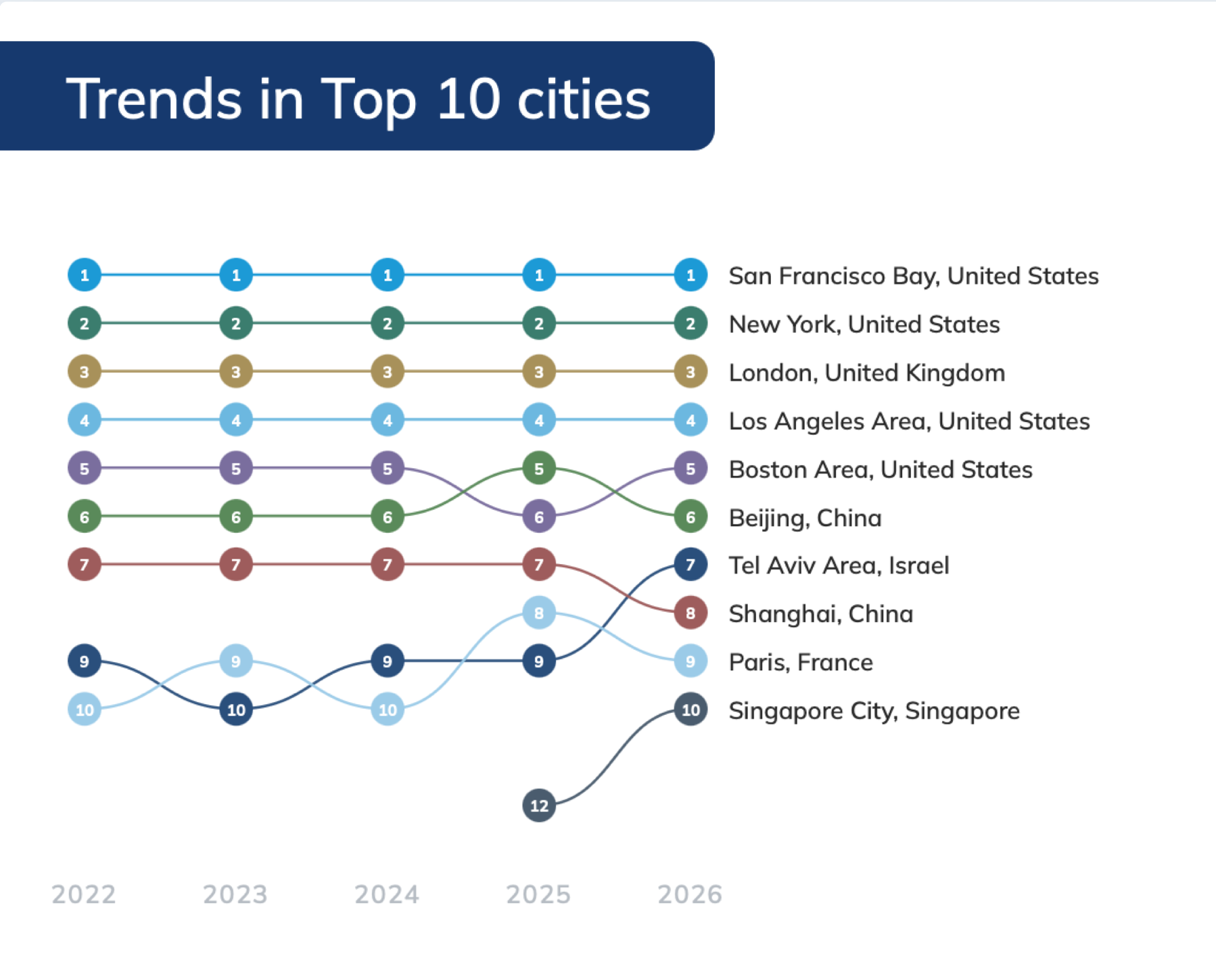
Beijing and Shanghai recorded the sharpest declines, falling by 21.4% and 20.0%. By contrast, New York and Singapore City posted clear double-digit gains.
Singapore City entered the global top 10 for the first time. Meanwhile, Tel Aviv rose to its highest position in five years.
New York also widened its lead over London. As a result, the gap between the world’s second- and third-ranked startup cities became more pronounced.
San Francisco Bay remains in a league of its own. Its lead over New York rebounded to 2.7 times, up from less than twice as high in 2023.

Top Cities for Startups | Global Startup Ecosystem Index 2026
| Rank 2026 | City | Annual Growth | Total Score 2026 |
|---|---|---|---|
| 1 0 | San Francisco Bay | +9.7% | 935.325 |
| 2 0 | New York | +11.6% | 352.159 |
| 3 0 | London | +5.4% | 197.557 |
| 4 0 | Los Angeles Area | +9.5% | 152.371 |
| 5 +1 | Boston Area | -1.1% | 127.119 |
| 6 -1 | Beijing | -21.4% | 107.678 |
| 7 +2 | Tel Aviv | +9.8% | 86.714 |
| 8 -1 | Shanghai | -20.0% | 81.430 |
| 9 -1 | Paris | -3.2% | 79.215 |
| 10 +2 | Singapore City | +26.7% | 78.854 |
Top 10 Cities for Startups
1. San Francisco
San Francisco remains the world’s leading startup city in 2026. It has held the #1 position since the Index was launched. With a growth rate of 9.7%, the ecosystem continues to build on its dominance.
Its lead over New York has rebounded to 2.7x, driven by the ongoing artificial intelligence boom. In addition, the region is home to more than 17,000 startups. While faster-growing ecosystems are emerging elsewhere, San Francisco’s structural advantages remain unmatched.

2. New York
New York holds its position as the world’s second-ranked startup city in 2026, recording 11.6% growth, the fastest among the country’s top three cities. It maintains a clear position between San Francisco and other U.S. cities, with a total score 2.3 times higher than the next-ranked U.S. city. New York stands out as the fastest-growing city in the top tier, outpacing San Francisco (9.7%) and London (5.4%).
The gap with London has widened, reinforcing New York’s position as a clear second global hub. As other ecosystems accelerate, New York continues to distinguish itself not just through scale but through sustained upward momentum.
3. London
London keeps its position as the top startup ecosystem in Europe and ranks 3rd globally in 2026 for the fourth consecutive year. With a growth rate of 5.4%, London continues to build on the sharp rise that took it from 5th in 2021 to 3rd in 2022. London remains the only non-U.S. city in the global top three.
While its growth rate is more modest than New York’s, London’s position as the anchor for innovation in Europe remains secure, with a score 16 times higher than the next-ranked UK city, Manchester.
4. Los Angeles
Los Angeles maintains 4th place in the global startup ecosystem rankings in 2026, continuing its remarkable rise from 10th in 2021. With a growth rate of 9.5%, LA has widened the gap with Boston and decisively broken what had been a close contest between the two. Los Angeles remains strong in industries such as Ecommerce, Hardware & IoT, Transportation, and Social & Leisure.
Despite not growing as rapidly as some of its peers, LA’s continued stability and strong industry clusters underscore its increasing global relevance in the startup landscape.
5. Boston
Boston climbs one spot to 5th place globally in 2026, now ahead of Beijing despite a slightly negative growth rate of -1.1%. Its rise in the rankings is driven more by Beijing’s sharp decline than by its own momentum, making it the only U.S. city in the top 10 with negative growth this year. Boston’s strength continues to lie in its deep specialization, especially in Healthtech and Energy & Environment.
With a strong academic and research backbone, Boston remains a magnet for innovation-driven ventures, though the recent contraction signals a need for renewed momentum to maintain its position within the global top five.
6. Beijing
Beijing drops one spot to 6th place globally in 2026, recording a sharp contraction of -21.4%—one of the steepest negative growth rates among the world’s top ecosystems. This marks a significant reversal for a city that had ranked 5th or higher in previous years.
Despite this decline, Beijing remains one of Asia’s strongest ecosystems, ranking among the global top positions in sectors such as Edtech, Hardware & IoT, Software & Data, and Transportation. The scale of the contraction, however, raises questions about the near-term trajectory of China’s leading startup hub.
7. Tel Aviv
Tel Aviv rises two places to 7th globally in 2026, with 9.8% growth, breaking out of the 9th-10th range it had occupied in recent years and moving closer to the top 5. This is its highest position in the last five years.
With top positions in Software & Data, Transportation and several other industries, Tel Aviv’s innovation ecosystem remains deeply rooted in technical talent and globally respected for its startup culture.
8. Shanghai
Shanghai fell one spot to 8th place globally in 2026, dropping out of the top seven for the first time since 2020. What stands out is the severity of the decline: a -20.0% contraction, among the steepest in the global top 10 alongside Beijing.
Despite this setback, Shanghai remains a significant force in several key industries, maintaining strong global positions in Hardware & IoT and Transportation.
9. Paris
Paris slips one spot to 9th place globally in 2026, with -3.2% growth. This reverses the strong momentum that lifted the city to its highest-ever ranking of 8th last year. Along with Boston, it is one of the only non-Chinese top-10 cities to record negative growth. Even so, the city remains a well-rounded ecosystem with strong positions in Fintech, Software & Data, and Ecommerce.
As Europe’s second-highest ranked city after London, Paris continues to be a major innovation hub. However, its recent slowdown suggests it may need renewed momentum to regain its upward trajectory.
10. Singapore City
Singapore City enters the global top 10 for the first time. It posted 26.7% growth, the highest rate among the top 20 cities. This rise reflects continued momentum rather than a decline elsewhere. In addition, it mirrors Singapore’s broader national performance, as the country ranks 4th globally.
With strong positions in Fintech and Ecommerce & Retail, Singapore City is establishing itself as a global-tier startup hub
What is the StartupBlink Global Startup Ecosystem Index?
The Global Startup Ecosystem Index
is an annual ranking of startup ecosystems around the world. In 2026, the Index ranks 1,556 cities and 120 countries, making it one of the most comprehensive global benchmarks of startup ecosystem performance.
StartupBlink builds the Index using hundreds of thousands of data points. Each ecosystem’s total score is based on three main subscores: Quantity, Quality, and Business Environment.
Quantity measures startup activity. Quality measures ecosystem impact and startup success. Meanwhile, Business Environment evaluates the national conditions that affect how easily startups can be established, operated, and scaled.
While this article focuses on the top 10 cities, the full report goes much deeper. It includes rankings, ecosystem trends, industry strengths, methodology, and analysis of more than 1,500 cities and 120 countries.
Curious to see where your ecosystem ranks? Download the full Global Startup Ecosystem Index to explore the complete rankings and methodology.
Frequently Asked Questions
Which top startup city grew the fastest in 2026?
Among the global top 10 startup cities, Singapore City recorded the highest annual growth in 2026 at 26.7%, reaching a total score of 78.854. Its entry into the global top 10 reflects Singapore’s growing strength as a global startup hub, especially in Fintech and Ecommerce & Retail.
Which European city is best for startups?
According to the Global Startup Ecosystem Index 2026, London is the top startup city in Europe, ranking 3rd globally with a total score of 197.557. It remains Europe’s leading innovation hub and the only non-U.S. city in the global top three. Paris ranks 9th globally with a score of 79.215. To compare London with other European startup cities, download The Global Startup Ecosystem Index 2026.
Which Asian cities are leading startup ecosystems in 2026?
According to the Global Startup Ecosystem Index 2026, the highest-ranked startup cities in Asia include Beijing (6th globally, total score 107.678), Shanghai (8th, 81.430), and Singapore City (10th, 78.854). Singapore City entered the global top 10 for the first time in 2026, while Beijing remains the highest-ranked Asian startup ecosystem overall.
What makes a city good for startups?
The Global Startup Ecosystem Index evaluates cities using objective and quantifiable measurements rather than opinions, surveys, or assumptions. It assesses each city’s startup ecosystem based on measurable output across three main areas: quantity, quality, and business environment.
A strong startup city is one with a high concentration of active startups and support organizations, demonstrated ecosystem outcomes such as funding, exits, unicorns, jobs, and traction, and local conditions that allow founders to launch, operate, and scale companies effectively. The strongest cities are not simply those that appear innovative, but those that show measurable entrepreneurial activity, impact, and sustained growth.
How are the best startup cities ranked?
StartupBlink ranks startup cities using hundreds of thousands of data points across startup activity, ecosystem quality, and business environment conditions. The 2026 Global Startup Ecosystem Index ranks more than 1,500 cities and 100 countries based on their total ecosystem score.